

Our Mission: To Spark A Realignment
STATEMENT OF PURPOSE
Ideas matter. Throughout history, new ideas have spelled the end of one era and the beginning of another, rearranging political coalitions and sparking realignments.
Today, we at the Searchlight Institute believe that a realignment is not just possible, but necessary.
In a nation divided in half, every election comes down to a coin flip while America becomes ungovernable. Nothing works. On the rare occasions progress is made, it is quickly reversed when the other side takes power. The inability of our government to deliver results saps Americans’ faith that democracy works for them, which feeds cynicism and erodes freedom.
This protracted political siege is likely to resolve into dominance for conservatives. For three straight presidential elections, President Trump has made inroads with core elements of the coalition that has traditionally supported liberal politicians. That pattern is likely to continue.
Yet at exactly the time when America most needs a new vision, liberals have become paralyzed by fear. Fear of each other, fear of disagreement, and fear of the American people.
That fear makes us small. We shrink from the world and put up yard signs that tell our neighbors not to knock unless they agree with us on everything. We flee to “safe spaces.” We cut people off over their politics and raise our kids to do the same.
Rather than assuage the fear, this insularity reinforces it.
Disengaged, we have come to rely on data to understand those we are afraid to talk to. But the data we rely on is rigged. To advance their pet issues by obscuring the complexity of the American people, a multimillion-dollar influence industry sprang up to tell us comforting lies—to feed us data that tells us what we want to hear, rather than what is true.
Rather than clarity, we get confusion. Rather than vision, we get spin.
Instead of building new coalitions and ushering in a realignment, we built a system that enforces purity and shrinks our tent.
To face the challenges before us, we must be unafraid of new ideas, unafraid of one another, and unafraid to see the American people clearly.
The Searchlight Institute exists to disrupt the dominant paradigm of smallness, purity, and fear. We will bring big policy ideas to a political milieu that has grown accustomed to thinking small. We will break down the ideological barriers that have imposed rigidity and separated us from our neighbors. And we will bring clarity to a data environment polluted by misinformation.
We are here to power the next realignment.
We invite you to join us.
SUPERMAJORITY THINKING
The Searchlight Institute is guided by Supermajority Thinking.
1. Supermajority Thinking is a necessary precondition of stable, majority-rule governance and policymaking.
Today, it is taken as a given that regardless of which party controls the White House, the president will win by a hair and preside over a narrowly-divided Congress. This is a recipe for instability: as we have seen, whatever meager agenda the administration manages to push through will be quickly undone when the other side retakes power, as they are likely to do in short order. Instead of aiming at bare majorities and getting there by appealing almost entirely to voters of one stripe, Supermajority Thinking aims at appealing to voters across the political spectrum. By scrambling ideological lines, this approach supports stability and durable policymaking.
2. Supermajority Thinking requires starting from first principles and following them wherever they lead—including when they take us outside of traditional ideological categories.
According to repeated efforts to chart the American electorate by ideology, the nation breaks down roughly like this: 43 percent liberal, 31 percent conservative, 22 percent populist, and 5 percent libertarian. Thus, there is no majority—let alone a supermajority—to be had in any of the traditional categories. To build a supermajority, we must defy ideological boxes and embrace a mix of positions from across the spectrum. We must refuse to accept as gospel what the current ideological lines are and instead ask: what are the policy outcomes we want to produce—abundant housing, energy, and health care; a government capable of delivering for the people it represents; an economy where workers enjoy the fruits of their labor and big corporations and the wealthiest Americans pay their fair share; the world’s best schools—and design policy with these goals in mind, ignoring special interests when they try to steer us away from them. We need an agenda that is as heterodox as the American people themselves.
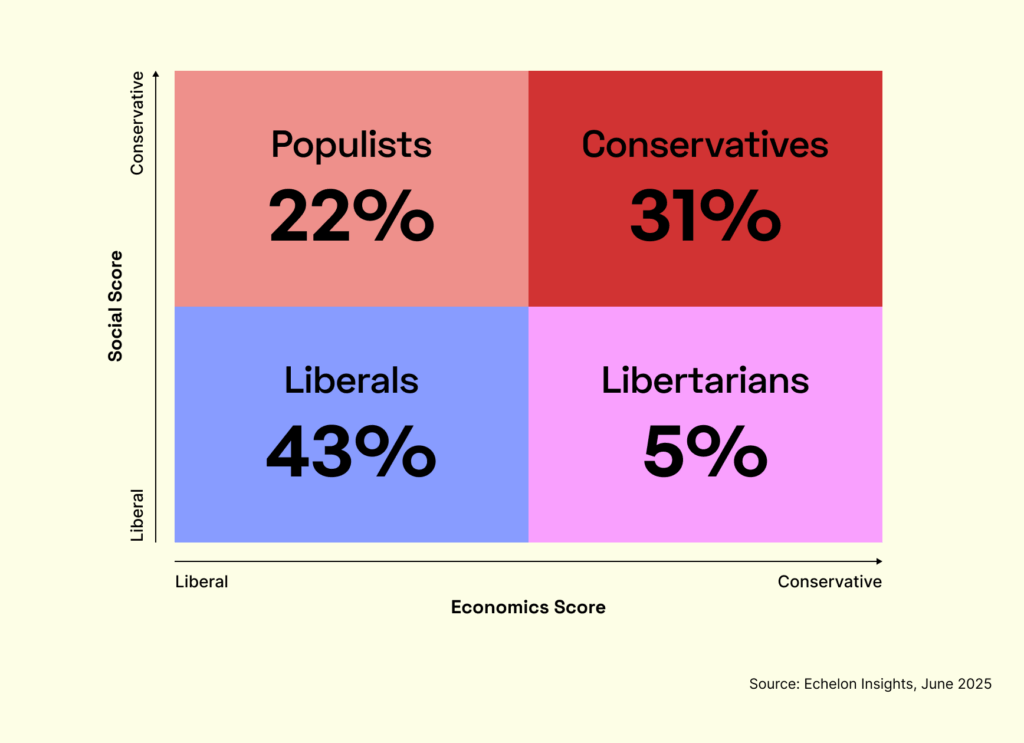
This spirit of heterodoxy is distinct from moderation: Whereas moderation points to the middle position along a left-right binary, heterodoxy breaks the binary and pushes leaders to embrace positions from different ideologies, regardless of whether the positions themselves are moderate or immoderate—or populist, libertarian, conservative, or liberal. It’s the mix that matters.
3. Supermajority Thinking is attentive to the American people, but sees public opinion as malleable.
In a democracy, listening to the American people and being responsive to their wishes is fundamental. When the American people feel ignored by their leaders, they become alienated and discontented—dynamics that feed authoritarianism. Used properly, polling and data can help us understand what Americans think and feel. This does not mean being constrained by polling—it means being informed by data. To craft the issue mix that will trigger a realignment, leaders need to know where they stand with the American people. Elected leaders can and should lead on issues that they care deeply about, even if they are out of step with public opinion. However, leaders should be clear on where the public stands, and not be fooled into thinking an issue is popular when it is not. They need to know when they are building capital with the public, and when they are spending it.
Today, there is a crisis of misinformation in the political sphere. Polling has become a lobbying tool, not a means of seeking truth. Interest groups cherry-pick the results they release, and shape question-wording to produce their desired results. As just one example: In 2022-24, as Democrats were hemorrhaging voters without a college degree, they let biased polling convince them that universal student loan forgiveness was popular. It was not—in fact, it would be hard to design a proposal more perfectly designed to tag them as the party of college-educated elites. After President Biden proposed universal student debt forgiveness, it became the economic policy voters heard about most and liked the least.
We reject that practice entirely. We are committed to producing transparent and intellectually honest polling, releasing all of our results, and holding ourselves accountable. Read more about our polling values here.
Ultimately, Supermajority Thinking leads to a pro-growth, pluralist, all-terrain populism—a populism that can go anywhere, and is not artificially cordoned off to a certain set of issues.
THEORY OF CHANGE
In The Semisovereign People, the political scientist E.E. Schattschneider writes, “The definition of the alternatives is the supreme instrument of power.” Our theory of change is that elected officials and other leaders trigger realignments by offering up new definitions of the alternatives.
This is how realignments have happened in the past, and how they will happen today. The existing set of issue positions embraced by each party has split the nation down the middle. Offering up a new mix can rearrange coalitions and trigger a new realignment.
We have become obsessed with tactics and lost sight of strategy. At a time when millions are being spent on rearranging deck chairs, the one thing we have not tried is taking issue positions that are more in line with the constituencies we seek to win over. From the New Deal era to the Reagan revolution, realignments are downstream of the positions leaders take. We cannot message our way out of an agenda that is profoundly out of step with the American people.
With a multi-million-dollar influence industry dedicated to keeping leaders inside the liberal box, taking positions that venture outside of it will create conflict. Rather than shy away from conflict, we must embrace it in good faith as a means of drawing clear distinctions.
POLICY VALUES AND DESIGN PRINCIPLES
“The country needs and, unless I mistake its temper, the country demands bold, persistent experimentation. It is common sense to take a method and try it: If it fails, admit it frankly and try another. But above all, try something. The millions who are in want will not stand by silently forever while the things to satisfy their needs are within easy reach.” – FDR
Our policy work is guided by four core values:
Fairness.
Pluralism.
Growth.
Security.
Our policy design is governed by two principles:
Policy is only as good as the results it produces.
Durable policy produces better results.
Policy approaches not primarily focused on results are more likely to lead to bad outcomes for those advocates claim to represent. Programs that do not have broad political buy-in are quickly rolled back or undone altogether.
Guided by our values and theory of policy design, Searchlight’s approach to policy will be defined by bold, persistent experimentation.
This spirit of creativity and innovation is severely lacking in an infrastructure that too often suffocates the kind of experimentation we need.
For example, the groups currently charged with generating new ideas would have rejected Social Security due to their overriding commitment to left-wing orthodoxy. Focusing on the elderly was itself a compromise, with the left demanding universal payments to all Americans in the form of the Townsend plan or Huey Long’s Share Our Wealth campaign—programs that could not have passed, even with Democrats enjoying enormous margins in both chambers of Congress. The policy design of Social Security would have been derided by today’s progressive think tanks because the benefits are financed by a highly regressive funding mechanism in the payroll tax. Yet FDR’s decision to focus on the elderly made the plan politically feasible, and his insistence on the payroll tax made it durable. Nearly 100 years later, Social Security remains highly effective and profoundly popular.
CONCLUSION
At most, realignments come along once a generation. Sparking one is a daunting task, and it starts with building infrastructure. While we do not claim to have all the answers—yet—we do claim to have created the institution that will discover them. By building a home for bold, creative thinking that is free to range across ideological boundaries and ignore the groups-think that has enforced rigidity for too many years, we will replace today’s reign of orthodoxy with a spirit of open, winning heterodoxy.
The process before us will not always be tidy, but it will always be interesting. Regardless of whether you agree with us—and especially if you do not—we invite you to come along.
Pretending climate change doesn't exist and tossing LGBTQIA+ Americans under the bus is quite the choice. Good luck with your ghoulish machinations -- this is certainly the era for it.
Taking billionaire money to fight against progressive policies. Adam Jentleson is a blight on the Democratic Party and if any of you were serious about making this world better you would donate your money to charity and then walk into the woods alone.