

Progressives don't need another Robert Moses
But we shouldn't accept today's paralysis either.
When California Gov. Gavin Newsom signed legislation last year cutting the red tape that too often thwarts infill housing construction, a certain class of progressives detected a disturbance in the Force — and this one for the good.
For decades, liberals had been focused primarily on what some call “demand-side” interventions in the housing market — programs designed to help those who can’t afford homes cover the rent or make down payments on mortgages for homes that already exist. Finally, after years of effort, a new breed had convinced the left to turn its focus to the “supply-side” of the problem — that is, the reality that there aren’t enough homes to rent or buy in the first place. And it was about time.
The shift had been born from a simple economic realization: No matter how much the government chooses to subsidize rents and mortgage payments, housing prices are inevitably going to go up in the absence of new construction.
Here, with Newsom’s bill signing, was a clear win for what New York Times columnist Ezra Klein has termed a “liberalism that builds” — a phrase he and his co-author Derek Thompson have since come to term “abundance.” Like with similar reforms passed in Arizona, Arkansas, Colorado, Iowa, Maine, and Massachusetts, construction under Newsom’s reforms would now be “as of right” or “ministerial” for certain types of units. No one’s discretionary approval would be required before the person who owned various sorts of properties could erect certain types of homes.
Housing advocates were right to be thrilled. In many cases, excess process is a primary barrier to additional supply. Beyond construction costs and financing concerns, abundant housing is often thwarted by the laws and regulations that empower neighbors to hold up a property owner’s plans to build what their heart desires. If, for example, they want to build a six-story apartment building near a subway station or bus stop, neighbors can prevail on the local zoning board or the city council to hold the plans in abeyance. Discretion, in essence, sits with the neighborhood and not with the property owner.
The bills Gov. Newsom signed, negotiated by members of the state legislature including State Senator Scott Wiener and Assemblywoman Buffy Wicks, were designed to thwart just those sorts of process-oriented impediments. To preclude neighbors and naysayers from vetoing worthwhile projects with these sorts of shenanigans. To push power down.
But successful as these reforms may prove to be, those who embrace the mantra of supply-side liberalism need to realize that the core arc of this narrative marks what may be an aberration to the generalized barrier to far-flung abundance. Far from facing circumstances where builders are beset by those wielding too many vetoes, in other venues they are held back by the reality that nobody’s in charge.
No one has the discretionary authority to determine where a new housing development can be sited, or where new train tracks will run, or how clean electricity will flow through the forest. Facing this distinct sort of problem, the solution isn’t to weed out process—it’s to empower the government to point the way forward expeditiously. But, particularly for Democrats, giving public authority that sort of raw power — in other words pulling power up — is much more unnerving.
The distinction marks a significant difference — and one that many who have embraced the mantra of abundance have yet to confront. When too many people wield vetoes over an individual proposal, salvation can be gleaned from giving a property owner more discretion. You need to do little more than permit the woman who purchased that lot near the subway to build her six-apartment building and you’ve got more homes.
Setting aside the construction cost and financing concerns that Klein and Thompson have begun to highlight, transfer what might be termed “the power to choose” from the neighbors to the lot owner and, voila, housing abundance. But that option isn’t available when you want to erect new ports, train lines, electrical grids, and other infrastructure across America. To build a new train track, or site a new transmission line, someone needs to impose decisions down onto property owners who remain adamantly opposed. And that, for progressives, is inherently out of character.
The Moses problem
This is what might best be termed progressivism’s Robert Moses problem.
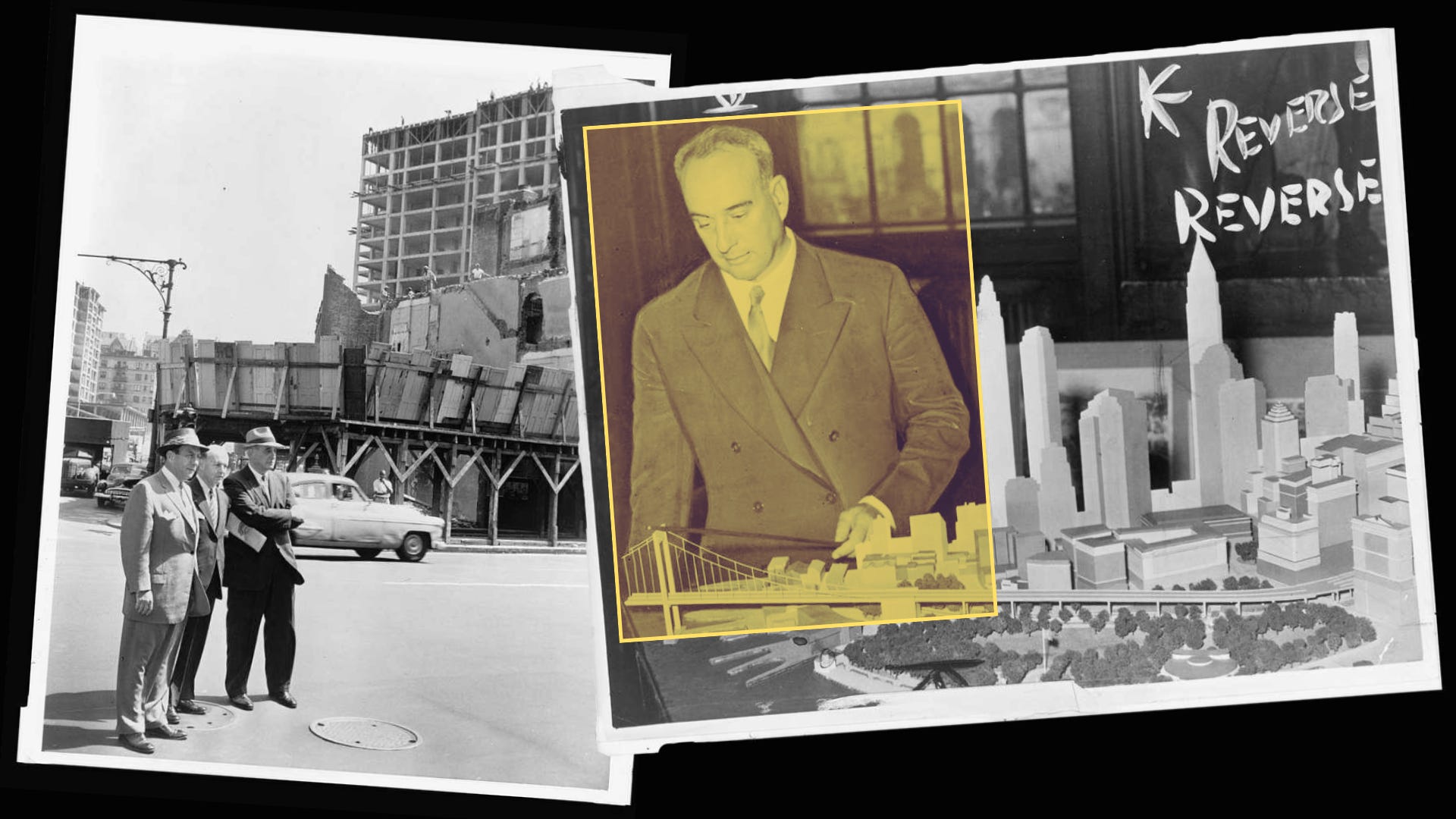
A half-century ago, the legendary author Robert Caro won the Pulitzer Prize for The Power Broker, a harrowing takedown of Moses, a purportedly apolitical bureaucrat who had served as the most powerful man in New York City from the 1930s through the 1960s. Moses had entered public life as a young man with what seemed like the best of intentions—a self-serious reformer determined to bring order to the chaos of machine-drenched politics such that, at long last, the good people of New York could have beautiful parks, modern housing, and rational roads and highway systems they deserved.
But over the decades that followed, as he amassed the power required to raze whole neighborhoods in the pursuit of better housing and to cut canyons across whole boroughs to make room for new arterial interstates, Moses became a political island unto himself. He lost sight of the effects his projects were having on the people whose homes were being demolished and whose communities were being destroyed to make room for what he considered to be “progress.” He came to wear so many hats and he held so much leverage over all the other players who might have stopped his bad ideas, that he could roll over any opposition. And he did. Even when a mayor, or a governor, or even a president objected to something he deemed to be in “the public interest,” he frequently got his way.
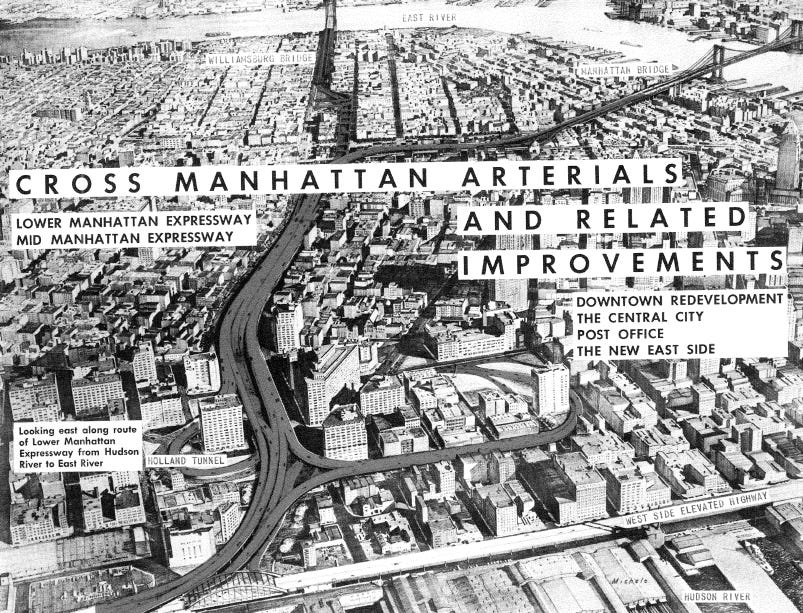
That turned out to be a problem. It would have been one thing if Moses’s judgment had proven impeccable. But as Caro made so painfully clear in The Power Broker, his imperiousness was not only cruel, it was often disastrous. Most famously, the Cross-Bronx Expressway turned what had once been a thriving hive of working-class neighborhoods north of Manhattan into an urban wasteland.
When, during a broadcast of Game 2 of the 1977 World Series, announcers Howard Cosell apocryphally responded to footage of smoke billowing out of a building near Yankee Stadium by noting that, “Ladies and Gentlemen, the Bronx is burning,” he was referring to the aftereffects of Moses’s impact on New York City. The expressway had forced people to scatter. Drugs had taken hold. Properties had become derelict. Arson had become endemic. The Bronx was in shambles. Moses’s dreams had become everyone else’s nightmare.
The Power Broker was of a piece with a broader progressive awakening about the essential scourge of centralized power. Powerful men wielding broadly unchecked authority had, by the 1970s, done America all sorts of wrongs. They had led us into Vietnam, and polluted the Cuyahoga River so badly that it burst into flames. They had flooded the nation’s streets with cars that were “unsafe at any speed,” in Ralph Nader’s iconic phrase, and sprayed chemicals on crops such that women had given birth to children with horrific disfigurements. They had built dams out West designed to subsidize agribusinesses to the detriment of family farmers and the environment alike. And finally, of course, they had gotten us into the mess of Watergate.
The cumulative effects on progressivism were profound. By the mid-1970s, the Democratic Party still purported to be about the same end goals — pursuing social justice and fighting economic inequality. But the movement’s zeitgeist had been turned upside-down. Once intent on centralizing authority in the hands of figures who would use big government to do big things, progressivism was now intent instead on invariably speaking truth to power. Reformers would work assiduously to ensure that public authority could never again be abused in Mosesesque ways to coerce or trample the indigent and meek. And that meant looking for new levers to check centralized authority. Environmental laws. Preservation statutes. Community consultations. In a word, process.
Today’s paralysis
It has now been 50 years, and largely without progressives noticing, the glut of procedure built up in reaction to Mosesism has itself become a problem. In many cases, that’s because the very processes progressives have championed to protect against new incarnations of Moses types have been weaponized against progressive interests. Environmental laws are among the favorite tools that those opposed to new housing use when trying to thwart proposals for new apartment buildings which, opponents speciously claim, will endanger some species, or imperil some precious natural resource. That’s exactly the problem that California’s new law is designed to address.
But that’s not the only problem that’s emerged from progressivism’s penchant for diffusing power. We’ve also made it increasingly difficult for government to make the sorts of decisions that figures like Robert Moses used to make with abandon and absent any real community consultation.
Somebody, in the end, has to decide where big housing projects, major port expansions, long railroad tracks, and interstate transmission lines are going to go. There is no way to handle that problem like California and other states are trying to handle neighborhood opposition to little housing projects. But what, we worry, would stop a newly empowered figure from pushing through another terrible project like, say, Moses’s Cross-Bronx Expressway? What would prevent the new train line from cutting right through the middle of a bucolic little suburb, or a historically minority neighborhood?
These aren’t just hypothetical problems. Americans who travel to Europe and Asia regularly come back and marvel not only at how fast the trains are, but at how embarrassing the trains are here by comparison. The Acela corridor connecting Washington, New York, and Boston should be comparable—the Northeast has the ridership and wealth to support the sort of service connecting London and Paris, or Beijing and Shanghai. Why doesn’t it?
The issue has nothing to do with the trains themselves—it’s the tracks or, more specifically, the right-of-way. For trains to be speedy, they need to travel in straight lines. The current route, cobbled together mostly in the 19th century, is incredibly curvy. To speed up, someone would have to purchase new, straight corridors through Maryland, New Jersey, Connecticut, and Massachusetts. Private landowners would have to give up their homes and farms. Beautiful forests and parks would be bifurcated by tracks. Habitats that are home to endangered species will be permanently altered. But on whose authority?
The same story is true when it comes to transmission lines. We can build new solar farms, or wind turbines, or geothermal facilities. But to get the electricity generated by these scattered facilities to the places that will use the electricity, we will need to build new wires, and those wires will need to traverse property where local landowners will object. Unlike with the owner of that lot who wants to build apartment buildings, there’s no way to push power down to the people who own the property, so authority will need to be vested in some more imperious figure, à la Robert Moses, or else nothing will happen. But how can reformers shape a system that allows for necessary things to be built without allowing for imperious figures to take things too far?
There’s no easy answer. The solution isn’t to let those who want to build have their way unencumbered, as was too typical before the 1970s. Utility executives shouldn’t be given unfettered power to string wires across endangered habitats. Railroads should not be able to route tracks through people’s homes without recourse. But surely someone should be empowered to balance public interests against individual rights. When three doctors with different specialties hover over a patient during an operation, one has to prevail in moments of disagreement or risk a fatality. When three military commanders have different ideas about how to pursue victory in the heat of battle, they either settle on a shared strategy or potentially yield to the enemy.
Too often, when progressives are faced with real tradeoffs in public policy, they have no real answer as to how to resolve substantive and legitimate differences. Ultimately, we need a plan for how to make a hard decision. That’s what those who support abundance need to figure out and articulate.
Admittedly, this may seem like a strange moment for a progressive to speak up for additional government discretion. President Trump, after all, struggles to honor even the most basic checks and balances. But MAGA’s appeal is born from a broad-based frustration that government doesn’t work—that ordinary people are being hoodwinked by some hidden deep state, and that only a would-be authoritarian can set things straight.
In reality, if public authority were to begin delivering again, voters wouldn’t be so drawn to Trump. And that’s the political tragedy of progressivism’s unending effort to box government in: It compels people who might support the Democratic agenda to vote the other way.
You needn’t be a Trump supporter to believe that government should have the capacity to weigh competing goods and make tough calls. When a high-up counterterrorism official working in the FBI’s national headquarters wants agents in one field office to spend their hours on one investigation, but the special agent in charge of that office deems another investigation a higher priority, the FBI director makes the call. When the electric company proposes to raise rates and consumers object, a utility commission decides what’s reasonable.
Not everyone is necessarily satisfied with the outcome, but the disputes rarely wind their way into court. The abundance movement needs to articulate how government should similarly resolve questions about housing projects, rail lines, and electricity corridors. The systems need to provide everyone a voice, but not a veto.
This isn’t the first time America has been frustrated by incompetent government. The progressive movement was born at the turn of the 20th century to address this same core frustration. In the decades since, the country has struggled repeatedly to balance the greater public interest with individual proclivities.
Here we are again. Our choice is not between Robert Moses and paralysis. But reformers need to articulate the means to a better medium. Until we do, the impulse to “speak truth to power” is liable to undermine Democratic efforts to reclaim a public mandate. Here is a case where good policy is the key to a better politics.
Name names!
The abundance movement walks a thin tightrope. Zoning and land-use regulations are valuable. Community input matters, and government should retain meaningful authority over what gets built where. The problem is not that these mechanisms exist; it is that they have metastasized beyond their original purpose, giving both institutions and neighbors veto power they were never meant to hold.
Abundance sometimes reads as though deregulation is the destination rather than a tool. Push too far in that direction, and you hand siting power back to utility executives and developers whose accountability runs to shareholders, not the public. That arrangement has a track record, and it is not a good one. But the answer to bad regulation is not its absence; it is better government, wielded with more discretion and less deference to whoever shows up to object.
The movement needs to reckon with this. You cannot build a liberalism that builds while flinching from the idea that someone, somewhere, with real public authority, has to make a hard call and be held to it.
- Stephen